


You may also like
-
Human Skeleton Poster
Institute of Liepzig · 1900 · Detailed human skeleton scientific print with crisp linework on warm beige paper
Poster from 103,50 kr · Framed from 184 kr
Regular price From 69,00 krRegular price -
Human Blood System Poster
Institute of Liepzig · 1906 · Detailed anatomical poster mapping blood circulation with red and blue vessels on beige
Poster from 103,50 kr · Framed from 184 kr
Regular price From 69,00 krRegular price -
The human body Poster
Augé and Claude · 1900 · Antique anatomical scientific print presenting the human figure with labeled study diagrams
Poster from 103,50 kr · Framed from 184 kr
Regular price From 69,00 krRegular price -
Human Musculature Poster
Unknown artist · 1894 · Detailed human anatomy scientific print showing musculature studies on warm beige paper
Poster from 103,50 kr · Framed from 184 kr
Regular price From 69,00 krRegular price


-

"Very nice Posters. The quality is amazing and we received it very quickly !"
-

"A shop to visit absolutely. Huge selection of posters. We spent more than an hour there !"
-

"Perfect to find gift. Price are very good. An they can frame and pack it on site"
About the Artist
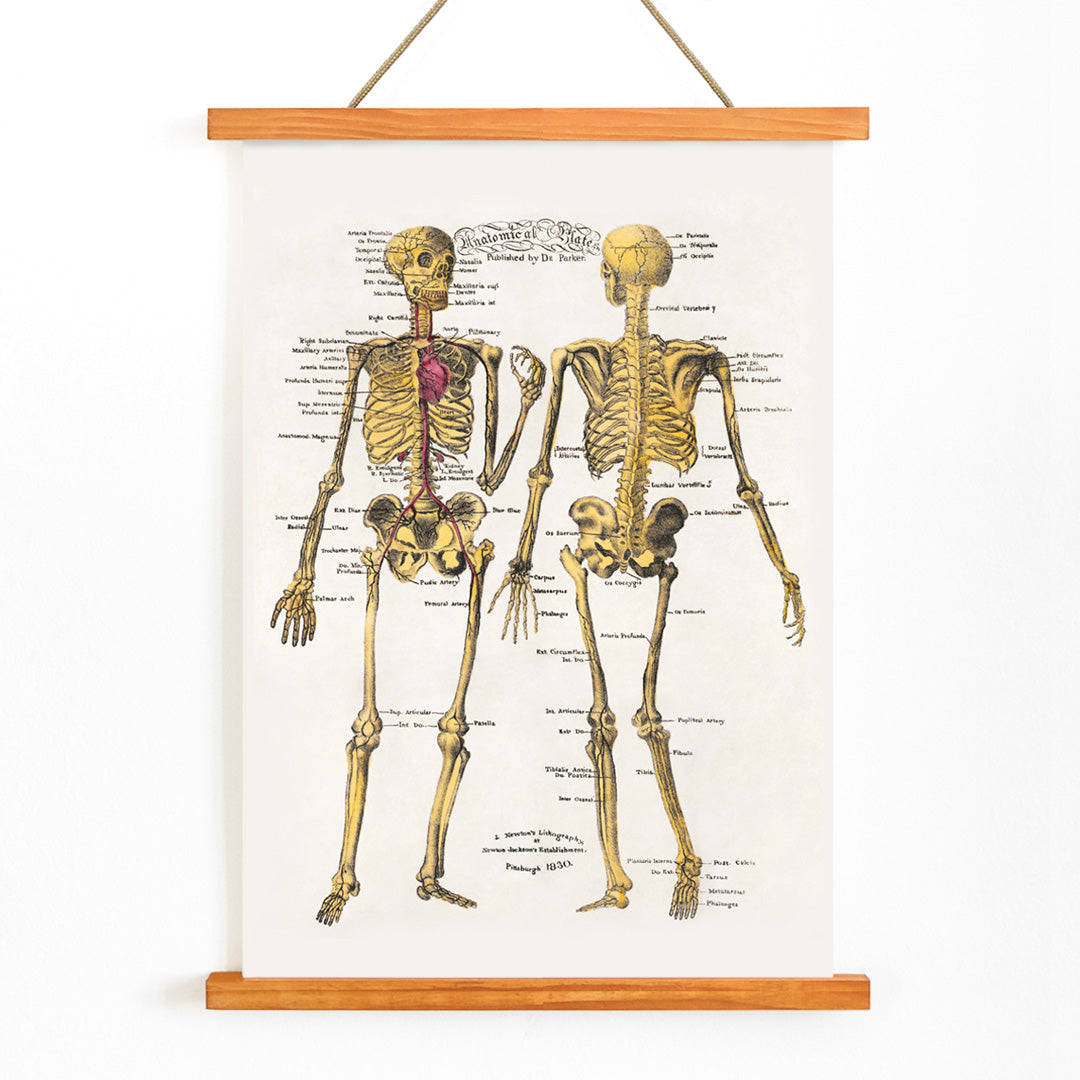
Dr. Parker is credited with these anatomical plates from 1850, created during a period when medical illustration was essential for teaching anatomy. In the nineteenth century, before photography became practical for widespread use, physicians and educators relied on detailed drawings to convey complex knowledge about the human body. These illustrations were indispensable tools in medical education, valued for their precision and clarity.
Rather than serving as personal artistic expression, works like this prioritized scientific accuracy and educational value. Dr. Parker's name is associated with this scholarly tradition, reflecting a commitment to advancing anatomical understanding through visual means.
The Artwork
This anatomical print was designed as a teaching aid for students, doctors, and anyone interested in the structure of the human body. Such plates were commonly found in classrooms, clinics, and private studies, helping to standardize anatomical knowledge and terminology. In the mid-1800s, illustrated charts like this played a crucial role in making medical information accessible and consistent across institutions.
Beyond its original educational function, this print now stands as a historical artifact, embodying the spirit of scientific inquiry and the pursuit of knowledge. It connects to a broader tradition of science wall art and complements collections of classic art with its blend of utility and elegance.
Style & Characteristics
The image features a full, front-facing human skeleton, meticulously rendered with fine linework and surrounded by dense anatomical labels. The careful arrangement of text and illustration ensures clarity and readability, while the overall composition maintains a sense of balance and order.
The palette consists of warm, aged paper tones contrasted with dark ink lines, giving the print an archival quality. Small accent marks highlight key anatomical points, and the mood is studious and calm, making it a timeless example of nineteenth-century scientific illustration. This piece fits naturally among black and white posters and other vintage educational prints.
In Interior Design
This vintage anatomical print brings a thoughtful, intellectual atmosphere to spaces such as home offices, libraries, studios, or medical practices. Its understated elegance suits both traditional and modern interiors, especially when paired with neutral walls and natural materials.
For a contemporary look, consider framing it in black or dark wood. It also works well in gallery walls alongside maps, diagrams, or minimalist art, and can be further enhanced by exploring our frames collection for the perfect finishing touch.